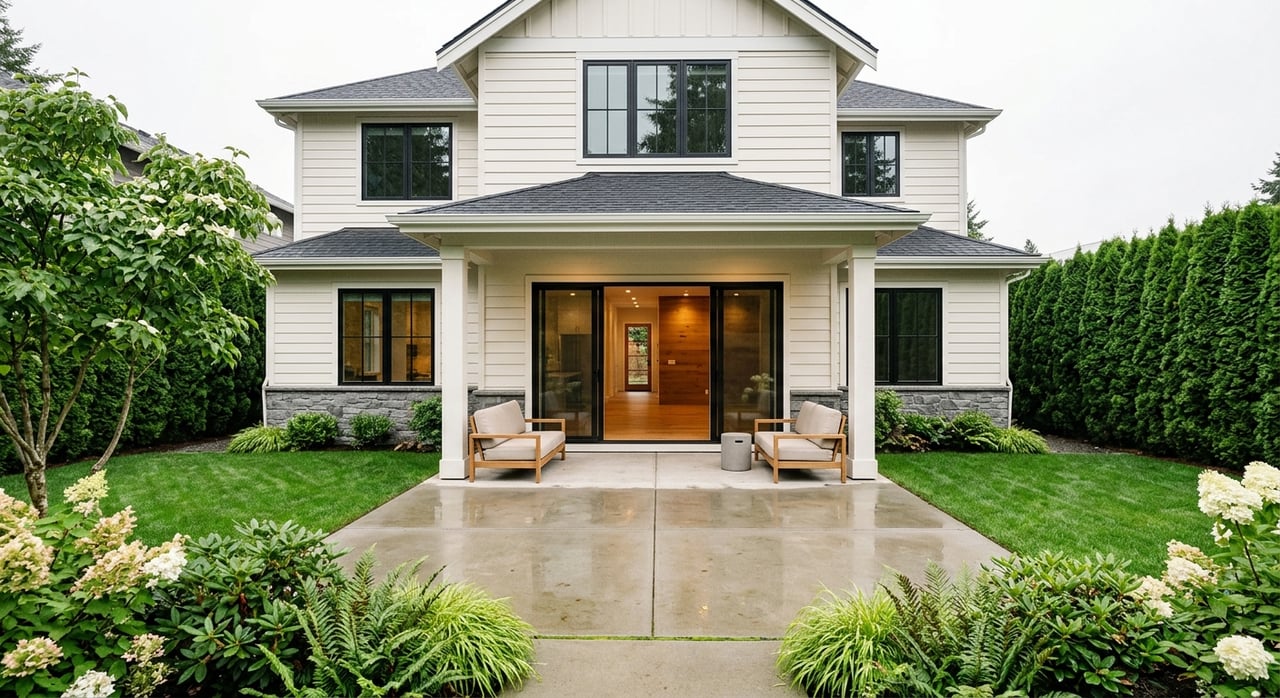
Wondering if it makes sense to move up to a larger home in Sammamish? If your current place feels tight, your storage is maxed out, or you want more functional space without leaving the Eastside lifestyle you already know, you are not alone. Sammamish is one of those markets where moving up often means refining how you live, not starting over somewhere completely different. Let’s dive in.
Why Sammamish fits move-up buyers
Sammamish is well suited to move-up buyers because it is already a strongly owner-occupied market with larger households and a housing stock that leans heavily toward single-family homes. Census data shows an owner-occupied rate of 82.6%, an average of 3.0 persons per household, and a median household income of $239,690. The city’s planning materials also describe Sammamish as a predominantly single-family community with a surplus of large single-family residences tied to a specific life stage.
That matters because moving up here often looks less like a dramatic relocation and more like a smart local trade-up. You may be looking for an extra bedroom, a larger bonus room, better separation between living areas, or a yard that works better for how you spend time at home. In Sammamish, those decisions are usually about fit, layout, and lot characteristics as much as they are about square footage.
What the current market looks like
Sammamish remains a premium market, and move-up buyers should plan around pricing in the mid-$1 million range. Recent March 2026 snapshots show a median sale price of $1,614,000 from Redfin and a typical home value of $1,638,223 from Zillow. Realtor.com also places the city’s median list price around $1.63 million.
Homes are still moving, but buyers have more choice than they would in a severe shortage environment. Redfin reported 53 homes sold with a median 5 days on market and about 2 offers on average, while Zillow showed 192 homes for sale and a median 7 days to pending. Realtor.com reported 217 homes for sale, 26 median days on market, and a sale-to-list ratio of 100%.
The big takeaway is simple: this is not a bargain market, but it is also not a market where you should assume every move-up purchase is a frantic bidding war. You may have room to compare options, especially if you understand the city by micro-market instead of treating Sammamish as one flat price point.
Neighborhood pricing is not one-size-fits-all
One of the biggest mistakes move-up buyers make is assuming that all of Sammamish trades in the same price band. Current neighborhood value estimates show meaningful variation across the city. Zillow places values at roughly $1.31 million in Klahanie, $1.37 million in Inglewood, $1.55 million in South Lake Sammamish, $1.61 million in Tam O'Shanter, $1.92 million in Pine Lake, and $2.72 million in West Lake Sammamish.
That range affects what “moving up” actually means for you. In one area, a larger home may still be attainable with modest compromises. In another, the same budget might mean choosing between lot size, age, updates, or interior square footage.
This is where local guidance matters. A candid review of your priorities can help you avoid stretching for the wrong home just because it checks one headline box.
The real tradeoff: house size versus lot size
In Sammamish, the move-up decision is often less about price versus price and more about interior size versus outdoor space. City rules place practical limits on how much house can fit on a lot. Sammamish states that single-family residences are limited to a 50% floor area ratio, and city brochures show maximum hardscape coverage of 30% in R-1, 40% in R-4, 50% in R-6, and 75% in R-8.
The city also notes that R-4 and R-6 zones have a 30-foot minimum lot width and a 3,000-square-foot maximum building footprint. In plain terms, a bigger house on a smaller lot usually means less yard and less flexibility later. If your dream is more indoor space and a meaningful backyard, you will want to pay close attention to the site, not just the floor plan.
Sammamish’s permitting guidance breaks lots into practical size bands, from less than a quarter acre to more than two acres. That helps frame expectations because the city truly includes everything from compact suburban lots to estate-scale parcels. For a move-up buyer, that variety can be a real advantage if you know what tradeoffs you are willing to make.
Where larger lots tend to show up
Official land-use materials help show how lot size can vary across Sammamish. A city land-use study describes Trossachs as low-density single-family development with typical lots around one-quarter acre, while High Country is described with roughly three-quarter-acre lots. Current listing examples cited in the research also show Sahalee around 0.28 to 0.34 acre, Klahanie around 0.46 acre, and Pine Lake examples around 0.34 and 0.83 acre.
These are not citywide averages, but they are useful signals. If your move-up goal includes a larger yard, more privacy, or room to spread out, you may need to target specific pockets instead of searching Sammamish broadly. If your priority is a newer home and more interior efficiency, a smaller lot may be the more realistic fit.
Older versus newer neighborhoods
Another key part of moving up in Sammamish is deciding whether you want an established neighborhood feel or a newer subdivision experience. According to King County assessor reports, areas such as Sahalee and Plateau Golf & Country Club are mainly homes built in the 1990s, while Inglewood and Tamarac are mostly late-1970s and early-1980s homes. On the south side, Pine Lake and Beaver Lake are described as established neighborhoods built primarily between 1970 and 2010, while Klahanie, Trossachs, and Aldarra are mainly 1990s-era neighborhoods.
That age split can shape your daily experience more than buyers sometimes expect. Established neighborhoods are more likely to offer mature landscaping, larger or less uniform lots, and homes that may need updates. Newer-feeling pockets are more likely to offer more consistent home styles, newer systems, and smaller yards.
Neither option is automatically better. It comes down to whether you value lot character, renovation potential, and landscaping more than turn-key condition and newer construction standards.
Think beyond the listing photos
If you are moving up for the long term, it helps to look past the obvious finishes and ask a few practical questions:
- Does the lot support the way you want to use outdoor space?
- Is the home already maximizing the site, or is there room for future changes?
- Are you paying for interior square footage you will use regularly?
- Does the layout solve the problems you have in your current home?
- Are updates likely to be cosmetic, or more significant over time?
This matters in Sammamish because city regulations already point toward more nuanced site planning. If you want the option for a future addition or major exterior changes, the lot and zoning details can matter just as much as the listing photos.
What future housing changes may mean
Sammamish’s 2024 comprehensive plan and code updates became effective on January 1, 2025, and are intended to widen the housing mix over time. The city also signals that future supply is more likely to come from Town Center and infill rather than large amounts of vacant land. Town Center planning now prioritizes apartments, condominiums, and affordable middle housing over market-rate townhomes, and the city’s rezoning framework allows a broader mix of detached and attached housing forms in several residential designations.
For move-up buyers focused on larger single-family homes, this likely reinforces an important point: the classic Sammamish move-up product is still valuable because future growth is not centered on creating huge volumes of new large-lot housing. Over time, choice may broaden across housing types, but that does not necessarily mean more abundant large single-family inventory in every price band.
How to approach a move-up purchase wisely
A smart move-up plan starts with clarity. Before you tour homes, define what “larger” really means for your household. More square footage sounds appealing, but the better question is whether you need more bedrooms, more storage, a dedicated office, a guest suite, a larger kitchen, or a better yard-to-house balance.
Then compare homes by micro-market, not just by price. A home in one part of Sammamish may offer more lot size but require updates. Another may give you newer systems and finishes, but with a smaller yard and less future flexibility.
Finally, stay disciplined about fit. In a premium market, it is easy to overpay for a home that feels exciting in the moment but does not actually solve your day-to-day needs. A calm, honest search process can protect you from making a move that is bigger on paper but not better in practice.
If you are thinking about moving up in Sammamish, the right strategy is usually a lot more specific than “buy the biggest house you can afford.” It is about finding the right mix of location, lot, condition, and livability for the next phase of your life. If you want candid guidance on how different Sammamish pockets compare and what tradeoffs are worth making, connect with Andrew M. Wenzl.
FAQs
What price range should you expect for a larger home in Sammamish?
- Recent March 2026 market snapshots place Sammamish broadly in the mid-$1 million range, with median sale and list prices around $1.59 million to $1.63 million, depending on the source.
What is the biggest tradeoff when moving up to a larger home in Sammamish?
- In many cases, the main tradeoff is interior square footage versus lot size and yard space, especially because city floor area ratio and hardscape rules limit how much house can fit on a lot.
Which Sammamish areas may offer different move-up options?
- Research points to meaningful variation across areas such as Klahanie, Inglewood, Pine Lake, Tam O'Shanter, South Lake Sammamish, and West Lake Sammamish, with different pricing and lot-size patterns.
How do older and newer Sammamish neighborhoods differ for move-up buyers?
- Established areas are more likely to have mature landscaping, larger or less uniform lots, and homes that may need updates, while newer pockets often offer more consistent housing styles, newer systems, and smaller yards.
Will future development create more large single-family homes in Sammamish?
- City planning materials suggest future supply is more likely to come through Town Center and infill with a broader mix of housing types, rather than large volumes of new large-lot single-family development.