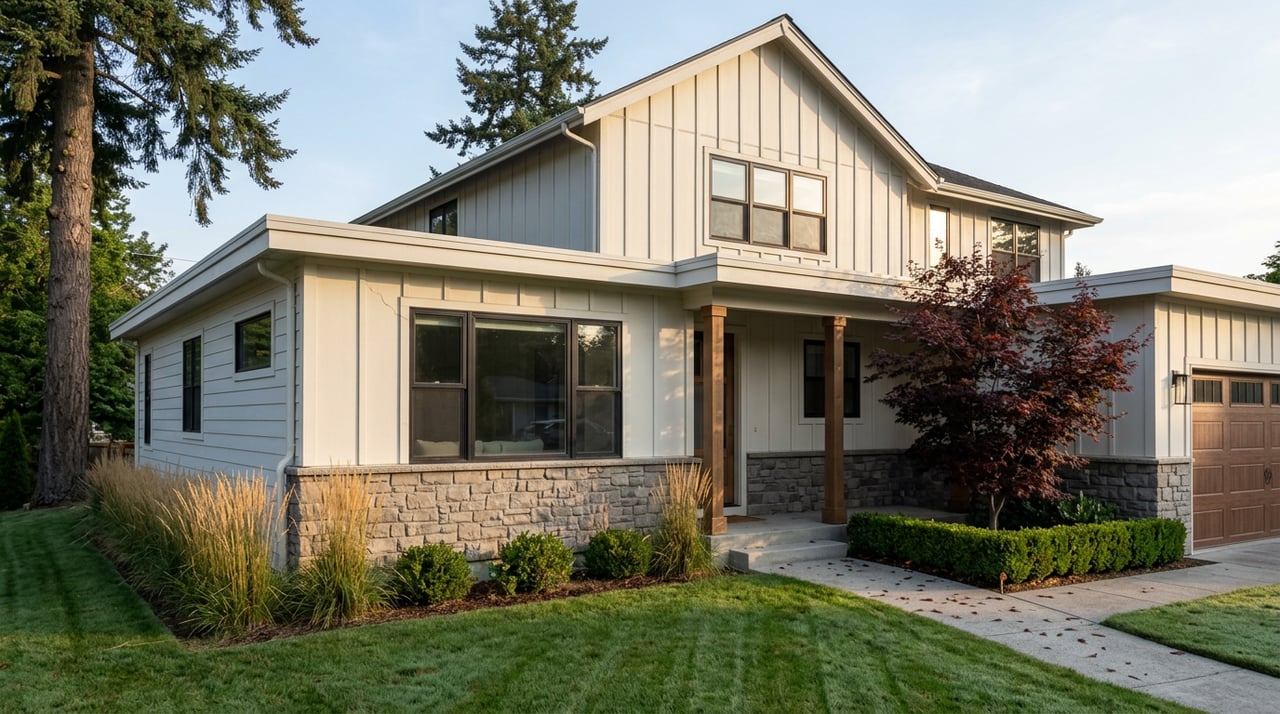
A family living in an older five-bedroom home along East Lake Sammamish Parkway decides to sell. They order professional photos, write up the listing copy, and then call the septic inspector King County requires before any title transfer. The inspector pulls the county's on-file records and delivers a number nobody in the house expected: the system was only ever sized to support three bedrooms. Two of the five rooms upstairs exist in the framing, the flooring, and the closets. They do not exist, legally, in the listing.
That is not a quirky exception. It is the actual mechanism behind why septic-served homes in parts of Sammamish get marketed, priced, and searched for differently than homes a few streets away on public sewer, and it has nothing to do with square footage or how many rooms a buyer can count on a walkthrough.
The Number on the Listing Isn't the Number in the House
Septic systems are sized around a concept called design flow, a projected volume of daily wastewater based on how many bedrooms a home has. Washington's on-site sewage rules calculate that flow per bedroom, then size the tank and drainfield to handle it. A system built or last upgraded when a house had three bedrooms was engineered for three bedrooms worth of flow, full stop. Adding a fourth or fifth bedroom later, whether through a permitted remodel or a finished bonus room nobody bothered to permit, does not automatically expand what the drainfield underneath the lawn can process.
King County's own program materials flag this directly. When the county revised its on-site sewage codes effective April 1, 2025, one of the specific technical corrections addressed how design flow gets calculated for single-family homes with more than three bedrooms. The county is not treating this as a footnote. It is actively refining the formula that determines how many bedrooms a septic-served home can legally claim, which means the constraint is current, enforced, and getting more precise rather than less.
For a seller, the practical result is blunt. If the septic system's rated capacity falls short of the home's actual bedroom count, the listing has to reflect the system, not the floor plan. The extra rooms get marketed as bonus space, a den, or a flex room. Buyers filtering their search by bedroom count never see the home at all.
Sammamish Is Actually Two Different Utility Maps
This friction does not spread evenly across the city, because Sammamish is not served by one sewer system. It is served by two districts with different footprints, plus pockets that were never absorbed into either build-out.
| Provider | What it covers |
|---|---|
| Sammamish Plateau Water and Sewer District | The plateau's urbanized core and portions of Issaquah and unincorporated King County; as of December 2020 the district's sewer service reached an estimated 50,792 people through 13,077 connections |
| Northeast Sammamish Sewer and Water District | The northeast portion of the city, including the Sahalee Way NE and 228th Avenue NE corridor up to roughly NE 12th Street |
| Private septic | Older parcels and rural pockets never fully connected to either district's sewer mains, including stretches along East Lake Sammamish Parkway |
The plateau's own comprehensive planning documents note that the older sewer infrastructure along East Lake Sammamish Parkway between Inglewood Hill Road and SE 43rd Way was originally engineered as an interim system decades ago, built to carry flows only until a larger regional connection was finished. That connection has faced repeated delays. It is a small piece of a larger pattern: a lot of what still relies on private septic in Sammamish sits in the older, lower-lying, or lakefront sections of the city rather than in the newer subdivisions built out closer to the plateau's center.
So the bedroom-cap issue is not random. It clusters in exactly the kind of neighborhood a buyer might target for character, lot size, or lake proximity, which means it is worth checking before falling for a listing photo rather than after.
What Actually Happens Before Closing
King County has required a septic inspection before title transfer since 2009, under Board of Health Code Title 13.60.030. The seller of any single or multi-family home served by an on-site sewage system must have a monitoring and performance inspection completed by a certified on-site system maintainer, or OSM, before closing. The OSM files that report with Public Health, and the seller separately records a Notice of On-site Sewage System Operation and Maintenance Requirements at the King County Recorder's Office, known on the standard paperwork as NWMLS Form 22U. The seller hands the buyer a copy before closing. At transfer, the buyer submits a required Operation and Maintenance program fee to Public Health.
There are a handful of exemptions: new construction that has never been occupied, systems with a recent inspection already on file, systems just permitted where the first required inspection is not yet due, and systems abandoned because the property has since connected to public sewer. Everyone else goes through the process.
Cost typically runs $300 to $900 for the inspection in the greater Seattle area, according to licensed septic providers, with the range shifting based on system size and how accessible the tank is. If the report turns up a problem, the sale does not proceed on the original timeline. The system has to be brought up to code before title can transfer, which is exactly why sellers who wait until an offer is in hand to schedule this inspection tend to regret it.
The State Is Catching Up to What King County Already Requires
Zoom out and King County looks less like an outlier and more like a preview. Washington is rolling a version of this same requirement out statewide, effective February 1, 2027. Snohomish County adopted its own local ordinance in April 2026 specifically to get ahead of that deadline, joining King, Skagit, and Island counties, which already required septic inspections at time of sale before the state made it mandatory everywhere.
What that means for a Sammamish seller is reassuring in one sense and worth taking seriously in another. The inspection process itself is not new or improvised. King County has run this system for over a decade, and there is an established network of licensed OSMs, a functioning county records database, and escrow companies that know the paperwork cold. What still catches people off guard is not the inspection requirement. It is the design flow ceiling sitting underneath it, quietly limiting what a home can be called on the market regardless of how many bedrooms it actually has.
What to Gather Before You List
- Pull your property's septic records early through King County's on-site sewage system database, which shows permit history and any as-built drawing on file
- Schedule the OSM inspection well before you plan to list, not after an offer arrives, since reports are valid for a defined window and repairs take time
- Confirm the system's rated design flow and bedroom capacity before you market a room as a bedroom rather than a bonus space or den
- Keep pumping and maintenance receipts, since Public Health may ask for maintenance history alongside the inspection report
- Know which utility footprint your parcel sits in, since a home on Sammamish Plateau Water sewer skips this entire process while a septic-served home a few streets away does not
A Few Common Questions
Does this apply if my home is already connected to Sammamish Plateau Water sewer? No. The King County inspection and disclosure requirements under Title 13 apply only to properties served by an on-site sewage system. Homes on public sewer through Sammamish Plateau Water or the Northeast Sammamish Sewer and Water District skip this process entirely.
What happens if the septic system fails inspection right before closing? The system has to be repaired and brought up to code before title can transfer. Since inspection reports are generally valid for about a year, scheduling the inspection early gives a seller room to handle repairs on their own timeline instead of renegotiating under deadline pressure.
How do I find out what my septic system is rated for before I list? King County's on-site sewage system records are searchable online, and a licensed OSM can pull the as-built drawing and design flow calculation directly from that file during the inspection. If no as-built drawing exists, the OSM will need to create one, which adds time worth planning for.
If you own a septic-served home in Sammamish and want a straight read on how this affects your listing plan, or you are house hunting on the plateau and want to know which streets carry this risk before you fall for a floor plan, Andrew M. Wenzl can walk through the specific records for your address. Let's Connect.